
Meg Barclay on how Doncaster’s Museums are contributing to overcoming barriers of access to health care and reduce health inequalities for local communities.
Heritage Doncaster is part of the City of Doncaster Council and is a heritage service formed in 2014. It operates the Council’s heritage sites including the Danum Gallery, Library and Museum, Cusworth Hall & Park, City of Doncaster Archives, and a network of branch and community-run local libraries. Through our service we deliver a variety of projects and services for local communities across Doncaster. These include our award-winning Creative Health programme: History, Health, Happiness.
Heritage Doncaster is a key partner in the UKRI Creative Health Boards initiative, working with local organisations of CAST and DARTs to investigate how culture can reduce health inequalities.
History, Health, Happiness programme
This award-winning programme is delivered by Heritage Doncaster’s community engagement and outreach team. It comprises projects designed to reach different audiences, many of whom find our collections and assets hard to reach. The projects are focused on supporting the mental health and wellbeing, and physical health conditions of Doncaster’s communities. The programme provides an active testbed for the UKRI Creative Health Boards research, demonstrating how cultural participation contributes to a fairer, healthier Doncaster. As such the History, Health, Happiness programme helps to overcome barriers of access to health care and reduce health inequalities for our local communities. The programme also promotes pride in the heritage and history of local communities, helping people feel more connected to where they live and provide a sense of place.
The History, Health, Happiness programme is currently for adults, although it has included working with families and young people previously. Participants attend through self-referring, as well as more formally through referrals from Doncaster’s Adult Social Care teams, Well Doncaster, Pure Physio, and third sector organisations also delivering creative health interventions.
From our interim evaluation report by Cara Courage, findings across all programmes show participants report consistent improvement in mood, connection and self-expression. Reach and partnerships have also expanded, deepening inclusion and representation, and through the programme, staff and participants are part of a shared ecosystem of care where wellbeing circulates between those who facilitate and those who take part.
Supporting mental health and wellbeing
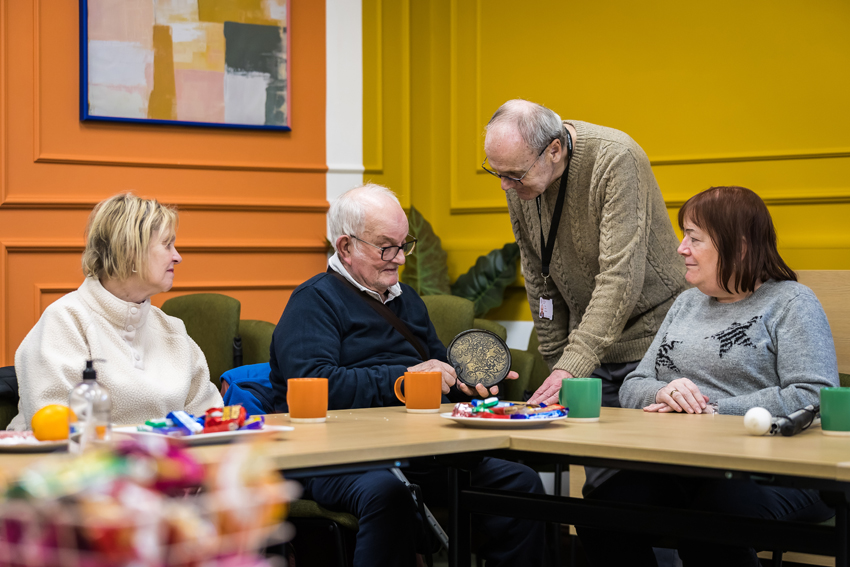
Each session within each History, Health, Happiness project is designed and planned around the 5 Ways to Wellbeing framework, so we can ensure participants are supported. Each session provides the opportunity for participants to come together and learn something new, handle real museum artefacts, participate in interactive historical activities, games and crafts, initiate new conversations, and form connections and friendships with others.
Supporting delivery staff is also key for the success of such projects. From previous evaluation reports by Arc Research Ltd, it was identified that delivering our History, Health, Happiness programme required significant amounts of emotional labour from staff which could lead to a risk of burn out and staff overwhelm, affecting staff resilience and wellbeing. As such all staff are now trained in Mental Health First Aid, Trauma Informed Practice and have the opportunity to attend bi-monthly Peer to Peer support sessions where a Wellbeing Peer Support framework designed by Bread and Roses is used to talk through any issues, challenges or situations staff may encounter, in the safety of an in person space away from the normal staff office, during working hours.
Current projects within the programme include:
• Feel Good Fridays – these sessions are based within Danum Gallery Library and Museum, alternating between the Art gallery and the Museum space. Each week adults explore different art and historical themes from Doncaster’s history through object handling, discussions and craft activities.
• Read and Rewind – sessions take place in both the Woodlands and Deneby areas of Doncaster. The project is a history-based shared reading group, where literature and poetry intertwine with Doncaster’s museum and art collections for a rich, multisensory experience.
• Herstory- sessions take place in the Thorne area of Doncaster. The project is a social group for women to explore the lives and stories of women throughout history through craft, storytelling and objects, and aims to build confidence and skills.
• Gallery Gather – a social club for adults between 18 & 36 years old with learning disabilities and/or autism, and their support staff. Sessions take place at Danum Gallery, Library and Museum. Participants attend 6 weekly sessions per project, co-curating a variety of outcomes such as gallery exhibitions and audio tours. Currently the group is co-curating our annual Moving Museum exhibition which is themed around animals. Once complete this will tour venues across Doncaster engaging with communities across the Borough
• Other community groups – each quarter we deliver sessions for local community groups such as B:friend, Alzheimer’s Society and Mind, providing fun interactive sessions which give participants of these organisation a taster of our programme and the opportunity to access our collections and try something new.
Supporting physical health
This year we have had the opportunity to trial a new project supporting our communities with their physical health needs too. This was very much a new area for us as a museum, and presented challenges as staff are not medical professionals. But of course, many mental health and physical health conditions often present together.
After consideration we identified the health condition of Chronic Pain would be most suitable for our museum. This was because:
1). We felt the model of Chronic Pain Cafés could easily be adapted to create a version which combined with our general History, Health Happiness session model.
2). People living with Chronic Pain often have mental health needs too and our staff are very experienced at supporting people with mental health needs.
3). There are currently over 400 people on the waiting list for Chronic Pain services in Doncaster. So we felt we could have some impact to the health inequalities of our communities almost immediately.
As staff are not medically trained, we sought the support of the Live Well With Pain organisation; undertaking training and consulting with their team of people who live with Chronic Pain. An area we wanted to test was if holding this group in our museum (rather than a clinical setting) would impact the efficacy of the activities; being in a setting that doesn’t evoke unconscious stresses would enable participants not to feel treated, and instead relax and enjoy the session.
We decided to call the project Feel and Flourish rather than a Chronic Pain café. Each week sessions combine object handling, gentle movement and guided visualisation techniques, inspired by these objects, along with written and verbal responses – all on themes chosen by participants – with a gradual buildup of physical activity as the 10 weeks progress. The aim of the sessions is not to overcome Chronic Pain – so participants move from experiencing pain to not experiencing pain. But rather to support and enable participants to live well with their Chronic Pain condition. Because, as one of the Live Well With Pain team put it to us ‘motion is lotion and this is what your group can support with’.
All activities are participant-led, undertaken at their own pace, and participants can take away some movement activities and mantras developed in the sessions to use at home. The sessions also loosely follow the 12 Footsteps for Change principles (the Chronic Pain programme developed by the Live Well With Pain team) so staff can also signpost participants to other information and services which may support them in the rest of their lives too. As such these two elements mean the sessions support participants holistically, rather than just during the two hour session they are with us in our building.
Initial feedback and evaluation has been positive, showing participants have really enjoyed their sessions; referring to them as treats and being like magic. Although more formal analysis of evaluation is ongoing, observations from staff show participants comment on how nice it is not to be in a medical setting, and they grew in confidence in terms of being in a museum space eventually feeling a sense of ownership over this space. Participants were also excited to learn new things and handle the objects each week. Staff observed participants would leave sessions with much more energy than they came in with, chatting and helping each other as they go.
There are of course challenges too. We have over 20 people signed up, but each session averages much lower numbers; often ranging from 3 to 7 participants each week. This is primarily due to the nature of Chronic Pain conditions; that a ‘bad day’ can never be predicted and people who have the best of intentions on coming, are not able to make it at the last minute. As such, it is quite a lot of work for staff and the museum, for often quite low numbers. However, this points towards the importance of museums measuring their provision in terms of the impact for the individuals, rather than the impact for the organisation; visitor impact rather than museum visitor figure impact. Overall, without this group, the individual participants that have come would not have had this support for their conditions and thus faced further barriers to accessing health provision.
Meg Barclay
Learning and Community Development Manager, Heritage Doncaster
This pilot project has been funded by the UKRI/AHRC Mobilising Community Assets to Address Health Inequalities Programme.
Published 1 April 2026