

For much of their early histories, museums spoke with a single authoritative voice and knowledge flowed in one direction, from institution to visitor. Today, this model is being challenged across the sector. Moving beyond just questioning it in principle, Sophie Hoffman explains how the V&A East Storehouse is designed to dismantle it in practice.
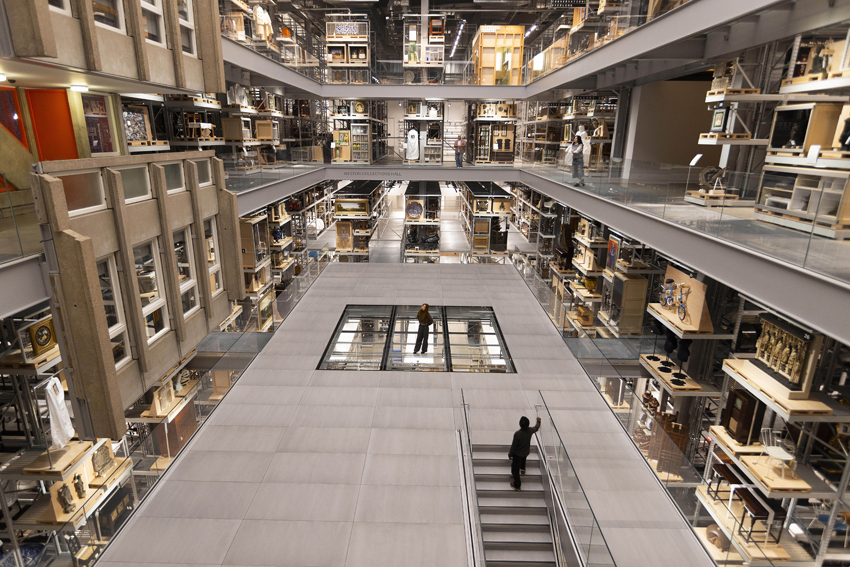
Opened in May 2025 as a new kind of museum experience, Storehouse is the V&A’s working storage space made publicly accessible: half a million objects arranged as they would be in storage, with 120 curated displays woven through the space for visitors to explore. The interpretation is deliberately light-touch – designed not to tell people what to think, but to spark their curiosity, prompt reflection and provide tools to find out more information. In its first nine months, Storehouse welcomed over half a million visitors.
Walking through the space reveals a range of voices to visitors. Text written by curators, conservators and technicians sit alongside those written by local designers and young people, with their names credited on the labels. Films retain the distinct tone of the people who made them. Audio points play oral histories shared by community groups. Visitor opinions are sought out and shared within the space.
Creativity has the power to bring change
Our target audience is 16 to 24-year-olds from the four east London boroughs surrounding the Olympic Park: Newham, Tower Hamlets, Walthamstow and Hackney. V&A East’s mission is rooted in a belief that creativity has the power to bring change, and that young people from our local communities should be at the heart of that.
Co-working is how we centre our audiences in that mission – producing for and with them. This allows us to include voices beyond the museum voice, recognising that our collection should be accessible to everyone to create their own narratives. Co-working enables us to support the next generation of artists and designers by increasing access to the collection – offering a sourcebook of inspiration that local young people, artists and creative practitioners can use to encourage new ideas or learn new techniques. And through working closely with our communities, we become a more integral part of the local creative ecosystem rather than something that exists apart from it.
Co-working also has a role in demystifying museums themselves. Part of what Storehouse aims to do is pull back the curtain on how museums work: how collections are built, who decides what stories to tell, what a career might actually look like. Co-working with communities to produce interpretation is a direct way we can do that.
The V&A East Youth Collective
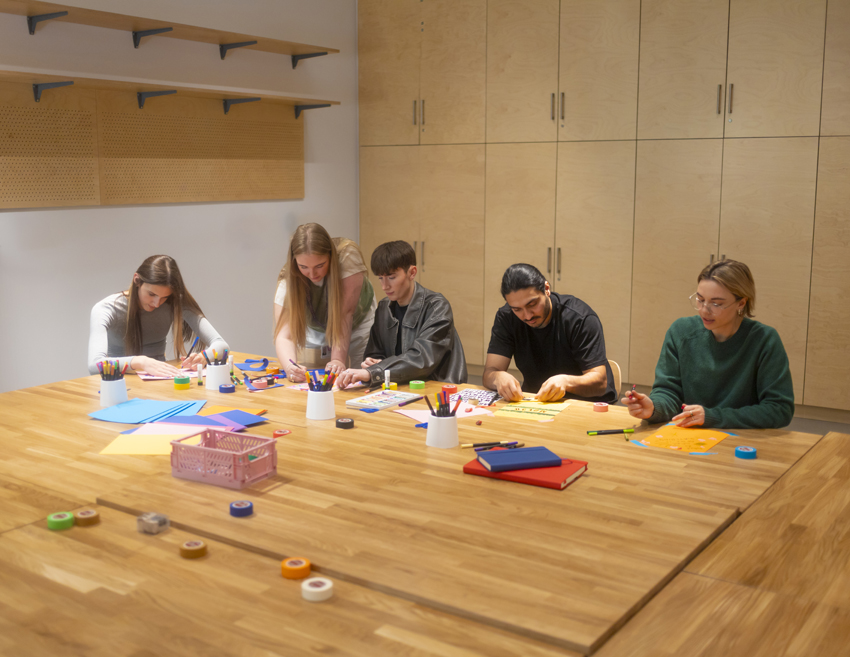
A key element of our co-working approach is the V&A East Youth Collective: a permanent programme of 15 young people who meet every two weeks and are paid the London Living Wage for their time. Members have been involved at every stage of developing Storehouse, from shaping the café offering to writing and editing labels.
Alongside the Youth Collective, the V&A East Learning team have worked closely with local community groups to explore some of the large objects in Storehouse. The team have collaborated with ex-residents of Robin Hood Gardens — a recently demolished social housing estate in east London — to record oral histories, create a new film and host workshops exploring the importance of social housing. These are on display alongside a fragment of the estate in Storehouse. We have also worked with South Asian dance groups to interpret the Agra Colonnade, which was made in India in the 1600s and is on display for the first time since 1957.
The V&A East Learning team also partner with local youth organisations, including Elevate and Hackney Youth Group. One example working with our audiences to ensure their perspectives are represented was the development of the David Bowie Centre, a new space within Storehouse housing the musician’s archive. We initially planned to follow a chronological narrative of Bowie’s career. Working with young people quickly revealed the problem: many of them had little familiarity with Bowie at all. We treated this as a design brief and completely rethought the story. Now the space explores connections between Bowie and artists who resonate with young audiences today, including Chappell Roan and Charli XCX. It centres themes important to them, including gender fluidity, activism and multidisciplinary creative practice.
Co-production in practice
We worked with the V&A Youth Collective to co-produce a display on objects connected to Ralph Bernal, a British art collector who made his fortune in the 1800s by enslaving people on his plantations in Jamaica. We know our audiences feel strongly about the complex histories around some objects in our collection, and about transparency around them, so we decided to co-produce this display to ensure their voices and perspectives were integrated and visible.
We ran skill-sharing workshops with Youth Collective members around developing text hierarchies and how interpretation intersects with design, giving members the confidence to have a genuine voice in the process. Being clear from the outset about what the finished labels would look like – the space available, the format, the word counts – meant participants could tangibly understand what they were working towards. They selected the combination of label types best suited to their ideas.
In a live writing and editing session at Storehouse, each participant drafted the key points they wanted to include. We input these directly into the label template, projected on a large screen, assembling the text iteratively – sparking new ideas and bouncing different phrasing off each other – until we reached a final version led by their choices.
One of their choices was not to name Ralph Bernal in the display. The group wanted the interpretation to centre the people he enslaved rather than to memorialise him. Visitors can use our digital database, the LookUp, to find out more about Bernal and his objects in the collection, or speak to staff.
“Our contributions are physically in the museum and cemented,” one Youth Collective member reflected. “We’ve had young people’s interests at heart, and it would be great to see how that’s continuing on.”

Polyvocal interpretation
One of the things that makes Storehouse unique is the embrace of polyvocality, by which we mean embracing many voices telling many stories.
In practice, this means that labels across Storehouse are written by a wide range of people: curators, conservators, tech services staff, community members, Youth Collective members, local residents and makers among others. Each label has the author’s name on it and the date it was published. Authoring labels is an act of transparency: it acknowledges that every piece of interpretation reflects a particular perspective and set of choices, and that no single story defines an object. It also means crediting the people who do the work, making the institutional voice less anonymous.
We also built change into the structure of the space. Displays will rotate regularly, with new voices and new stories being displayed. This is partly a practical response to the nature of a working store, but it also means Storehouse moves beyond presenting one settled version of what the collection means.
Visitors as part of the interpretation
We want visitors to feel like they are part of the storytelling at Storehouse. One way we do this is through Visitor Expression Points: spots where visitors are invited to respond to genuine open-ended questions and to read what others have said.
These are questions that we, as museum professionals, often do not have settled answers to. The first question asked what the V&A should be collecting. Responses are gathered and fed back to staff.
The principle behind this runs throughout Storehouse. Visitors bring valuable knowledge and perspectives with them, through lived experience, creative practice or their own expertise. Visitor Expression Points are one way of signalling that the conversation about what these objects mean is open and ongoing, and that what visitors think is valued.
Demystifying museums and opening doors for young people
We are still learning and evaluating how our interpretive approach is landing – which elements encourage the kind of transparent exploration Storehouse is designed for, and which may need developing further. That feedback will loop back into how we work. We hope V&A East Storehouse continues to be a vibrant hub for creativity – opening doors for young people, demystifying museums and providing a sourcebook for inspiration.
Sophie Hoffman
Interpretation Editor, V&A East
Published 9 March 2026