

Edward Blake and Julien de Sainte-Croix on the thinking and technology behind Phrontisterion, Mona’s $100 million underground library in Tasmania. Challenging traditional classification, Phrontisterion uses computer vision and curatorial experimentation to spark new connections between books, ideas and visitors.
“A book is not an isolated being: it is a relationship, an axis of innumerable relationships.”
Jorge Luis Borges (Fictions, 1944)
There is a museum down in Tasmania called Mona. It has been referred to as the Disneyland of sex and death. Itʼs more than that, but suffice to say that when the founder, David Walsh, mentioned that he was building a new underground library, named Phrontisterion, as part of the museum, we knew we wanted in. Thankfully, David had Art Processors in mind. The company was born out of Monaʼs founding back in 2011 and has continued to work closely with the museum ever since.
He shared a “briefˮ for the library. We put “brief” in quotes because it was more like a vision built on provocations and questions, all packed into one long text message. Itʼs too long to share here, but we’ll provide a couple of excerpts for context.
David: “We can, at whim, move art around to say what we like to say with art. Today we emphasise colour, tomorrow connections with dada, or medium, or country of origin. Why canʼt we do this with books? Because, if we move them around, we canʼt find them anymore.ˮ
“I want a system where we can move books arbitrarily, but still know where they are…Books become interwoven objects, with the links between them spun by librarians who are curators, and who can, as well as highlighting knowledge, and learning, can highlight artistry.ˮ
It might have come via text message, but this was one hell of a brief.
Others have grappled with the limitations of classification. Art historian Aby Warburg (1866-1929) believed that the mass production of books had made arrangements mechanical rather than scholarly. For his famous library, he devised “the law of the good neighborˮ, the idea that books should be placed near one another with the intent to spark unexpected connections, or to support or challenge the ideas contained within.
The inventor Vannevar Bush (1890-1974) came at it from the other end, recognising in 1945 that machines would be better equipped than humans to parse the huge amounts of written material and could provide both indexing and “associative trailsˮ, making thematic jumps similar to how our brains work. He called his idea “the memexˮ.
“This was not an art installation. This would be a functioning library with a team of librarians and easily a thousand visitors in a day.”
The brief gave us plenty of ideas to explore. We also had to think about the people who would live and work among the books, and what they would need the library to be. This was not an art installation. This would be a functioning library with a team of librarians and easily a thousand visitors in a day. As the artist Donald Judd once wrote, “Design has to work. Art does not.ˮ
We landed on a triptych: David provided the vision and the collection, the librarians were the curators and day-to-day operators of the system, and the visitors were our seekers: curious minds on a search. We had plenty of experience making exhibitions, but little precedent for a brief like this, where even the arrangement of books on shelves was open to question.
Our three perspectives helped us judge proposals while so much remained undecided: what they preserved of the original vision, what they asked of the librarians, and what they made possible for visitors. To get moving, we split the work into two streams. The experience designers could explore what a library like this might offer, assuming for the moment that the books could be tracked. The technology team had to work out how to make that assumption hold.
RFID, already common in lending libraries, came with a prerequisite: someone had to catalogue each book and link its record to the tag. Even then, the tag could not tell us exactly where the book sat on the shelf. What if the book could identify itself? Its spine could give us our first clues, without needing a record to match it against. Computer vision could locate the book on the shelf and help us catalogue it on the fly. We could start with the book itself and let the record follow.
We brought in a specialist with a PhD in computer vision. His proposed approach required markers on book spines and extensive preparation of training data. We began designing the markers, briefly accepting his requirements as ours. We would have spent years manipulating and adjusting the collection to make it work with the technology. That was a lot to settle while we were still discovering what the library could be. The book identifies itself. That was the requirement.
“The demonstrations had people telling stories about the museum and imagining ways visitors could play with the system. What we’d built to demonstrate book tracking was giving the room ideas for the library experience itself.”
Our approach didn’t need to be bulletproof. It just had to provide a reasonable level of accuracy and be flexible enough to adapt to new advances in the technology we were using. As David likes to say, “Inspiration is a poor substitute for iteration.ˮ And so, after roughly a year of configuration and reconfiguration, we had a technical approach that relied solely on the natural book spine, required far less training, and provided the accuracy we needed.
Along the way, we brought the design and tech work together in prototypes for the wider Mona team to try. The first showcase used 100 books on an IKEA bookshelf in our office. The second used a portion of the old Mona library and roughly 500 books. By the third showcase, we had incorporated the whole of the old library, approximately 5,000 books.
The demonstrations had people telling stories about the museum and imagining ways visitors could play with the system. What we’d built to demonstrate book tracking was giving the room ideas for the library experience itself.
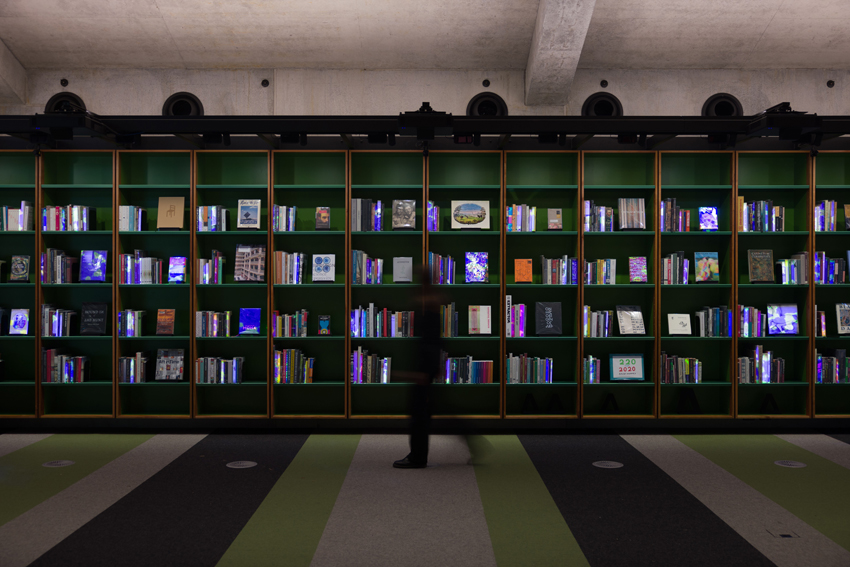
We were working out how to find books wherever they were put. In the process, the computer vision approach had given us a digital counterpart to the shelves, with a position for every spine. Those positions turned out to be useful for something else. Digital associations let a book keep company with any number of others. A physical shelf makes us choose its neighbours. We realised the coordinates we used to locate books could also tell a projector where to cast its light, a perfect opportunity to show relationships beyond those suggested by the arrangement.
These became our “live baysˮ. Touch the cover of a displayed book and related books light up along the shelves. Move books around or swap them out, and the system tracks their new positions in near real time.
The same freedom to move books had to work across a collection of over 30,000. Visitors and librarians still needed to find the book they wanted.
The O, Monaʼs mobile guide, already gave visitors information about the art around them. David’s original brief called for extending it to the library: “down this aisle, third row from the top, 8th book to the left. No numbers or coding, just instructions.ˮ Does Phrontisterion have a copy of Isaac Asimovʼs I, Robot? Check the O.
And, better still, the O can provide a range of associations similar to those in live bays. Want to know how David got from The Idiot to The Guinness Book of World Records? Check the O. It will show you the way. Live bays worked with a select portion of the collection, but the O knows it all. Itʼs central to the Mona journey, so it was only natural it would be a key part of a visit to the library.
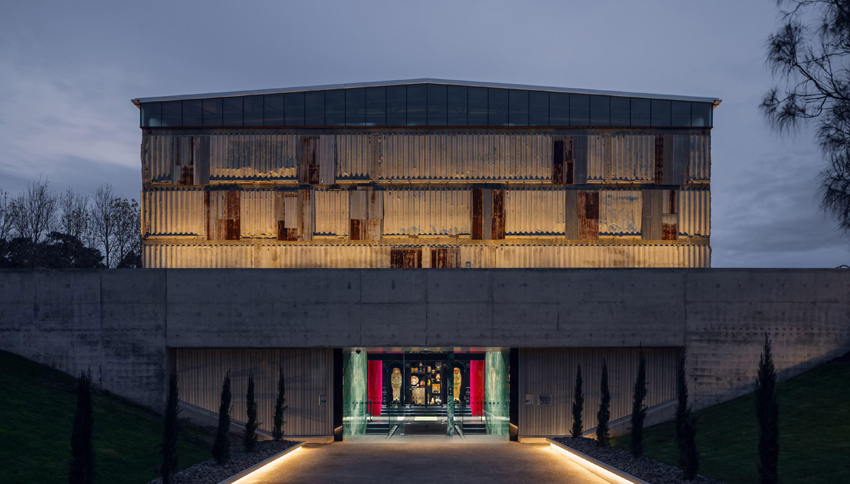
The doors opened, and over 85% of museum visitors came through Phrontisterion, compared with around 25% in the old Mona library. By the time visitors reach Phrontisterion, theyʼve spent a good while underground in a museum that sets out to challenge them. Their heads are swimming with ideas sparked by the art. Among the libraryʼs sculptural ironwork, Egyptian coffins and David Bowieʼs handwritten Starman lyrics, there is the reassuring sight of people absorbed in books. You can settle in here.
Even sex and death are there on the shelves. Sitting alongside mythologies, numismatics, wine compendiums and the history of cricket. Associations in the O might lead you one way; a conversation with the librarians, another. There is room to follow your impulses, or simply to read for a while.
Forgoing classification made us responsible for decisions it would otherwise have made for us. We needed our own constraints, but we couldn’t settle them all at the beginning. They developed through making and iterating. We could keep questioning the shape of the library while making something increasingly compelling.
The library is open, and its arrangement can keep changing. Books can be brought together for what they say to one another, then moved when there is something else to say. The system gives the librarians room to keep making choices, and visitors a chance to discover something we never thought to show them.
Edward Blake, Open Field Studio and Julien de Sainte-Croix, Art Processors
Published 6 October 2026