

Mika (Jaeyun) Noh examines how AI is reshaping museums, from AI-generated interpretation and personalised visitor experiences to questions of authorship, bias and accountability. As AI gains influence over how culture is presented and understood, museums must establish clear ethical frameworks to protect public trust and ensure that human judgement remains at the heart of curatorial practice.
Museums have long been sites of technological experimentation, from climate-controlled galleries to digital archives. However, the integration of generative AI represents a seismic shift. Unlike previous innovations that merely enhanced access, today’s intelligent systems claim interpretive agency. They generate exhibition narratives, recommend personalized visitor pathways, and produce artworks that challenge our fundamental understanding of authorship.
When an algorithm curates a collection, it is not merely a tool; it is a cultural author, one whose “decisions” encode the biases and power structures embedded in its training data. As public trust in institutions becomes increasingly fragile, even as the 2026 Edelman Trust Barometer ranks museums among the most trusted global entities, we face a critical question: Can AI-mediated experiences maintain the authenticity that underpins the social contract?
The Four Pillars of the AI-Enabled Museum
To understand this transformation, we must map the institutional terrain. Drawing from my research for ArtTable (2026), I propose a four-pillar architecture that governs contemporary cultural production:
1. Law: Rights frameworks defining what counts as authorship and legal liability.
2. Policy: Funding mandates that increasingly tie resources to “digital readiness.”
3. Platforms: Infrastructure determining visibility and how audiences encounter culture.
4. AI Systems: The underlying “grammar” that filters and recombines cultural knowledge.
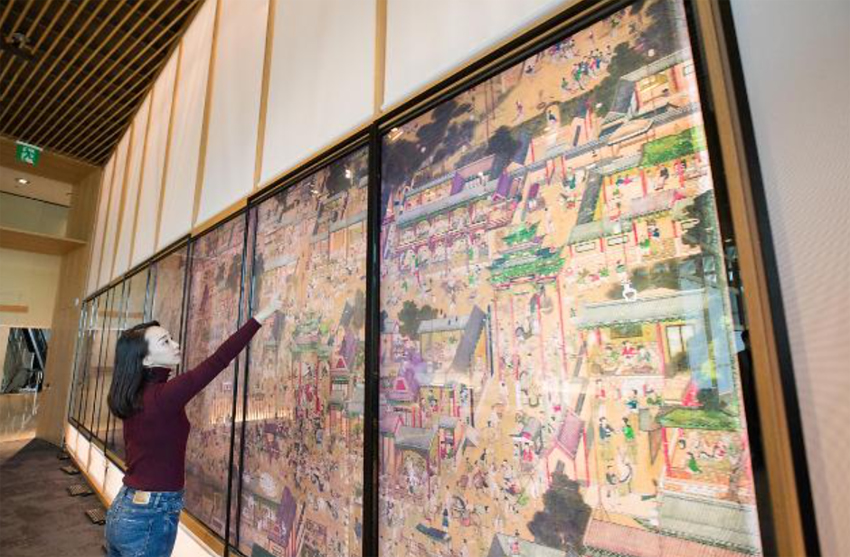
When the National Museum of Korea deployed AI-animated visualizations of the historic Taepyeongseongsido, these pillars collided. Legal questions arose regarding training data scraped from public collections (KIPO Guidelines, 2023), while platform dependencies on commercial AI vendors created concerns over cultural sovereignty.
From Venues to “Platform Museums”
Museums are evolving into data-driven platforms competing with Netflix for attention. Korea’s Smart Museum Initiative has digitized over 100 institutions since 2021. The National Museum of Korea now utilizes AI docents that analyze real-time visitor behaviour, gaze tracking and dwell time, to generate hyper-personalized routes.
However, personalization has a cost. In a 2025 pilot at Korea’s National Folk Museum, visitors reported 87% satisfaction, yet 42% missed contextual galleries entirely due to “algorithmic overwhelm.” When we are routed only to what the system thinks we like, we risk fragmenting into recommendation silos, losing the shared cultural memory that museums are designed to foster.
AI and the Ethical Minefield: Authorship and Accountability
The Authorship Question
In 2025, U.S. appellate courts solidified the “human authorship only” doctrine. This transforms museum commissioning. In my analysis of Anna Ridler’s Mosaic Virus (Doma Magazine, 2025), I explored how AI-generated images encode governance decisions. Ridler hand-labeled 10,000 photographs; she wasn’t just training a model, she was performing an act of cultural authority. Museums must realize that when AI generates a label, it reflects the biases, racial, gendered, or colonial, present in its training set, a phenomenon Safiya Umoja Noble describes as “Algorithms of Oppression.”

Accountability Beyond the “Black Box”
The EU AI Act (2026) and Korea’s AI Basic Act (2026) now classify many cultural applications—such as biometric visitor analytics—as “high-risk.” Institutions are now directly liable for algorithmic harms. If an AI docent systematically routes visitors away from certain galleries due to historical gaps in training data, the museum bears the moral responsibility. As Virginia Eubanks warns in Automating Inequality, opaque systems often quietly reinforce historical inequities.
“Opacity is not neutral; it is a political choice that undermines institutional legitimacy.”
Toward Human-Centered AI: A Practical Framework
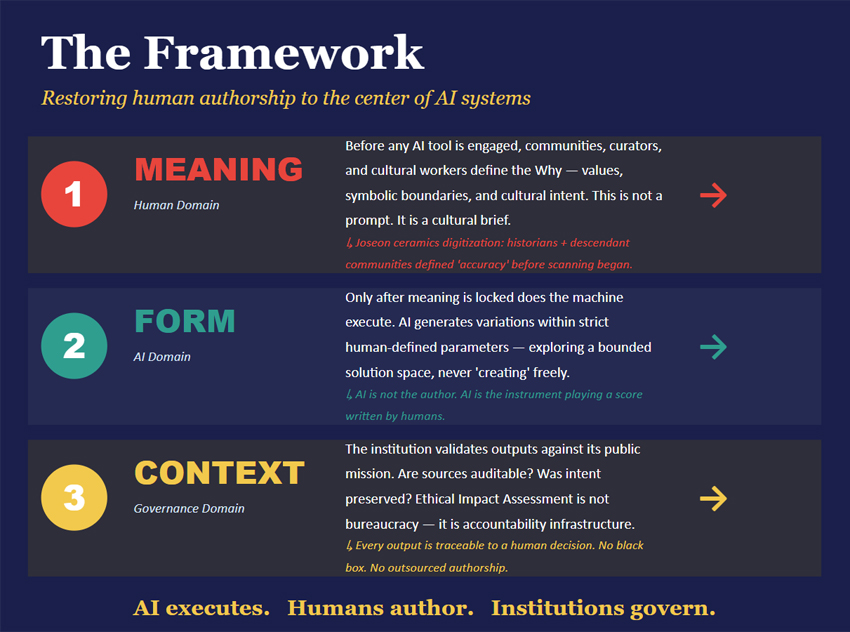
To move from passive adoption to active governance, I propose the Three-Layer Co-Creation Model (Noh, 2026):
The three-layer co-creation model reasserts curatorial authority in the age of generative systems by structuring AI collaboration around meaning, form, and governance. First, curators must define ethical frames, thematic priorities, and exclusions before any generation occurs, encoding institutional values into system design rather than retrofitting ethics after outputs are produced. Second, AI should operate within locally grounded datasets -community archives, environmental data, oral histories – while all iterative decisions are documented to preserve institutional memory and accountability. Finally, institutions must evaluate AI outputs against mission, public trust, and legal obligations through transparency, data governance, and clear responsibility structures, preserving what I call curatorial hesitation – the interpretive and ethical deliberation that constitutes cultural intelligence. In this model, AI is positioned not as an autonomous curator but as a constrained collaborator within human-defined epistemic and institutional boundaries.
Intent-Driven Constraints
Museums must reject “algorithmic defaults.” A generic prompt for “Future City” often yields a techno-orientalist, cyberpunk cliché. An intent-driven approach forces the AI to work within specific parameters – such as “ecological repair” – using locally grounded datasets rather than generic internet scrapes. This resists the “algorithmic flattening” I documented in The Seoul Algorithm (2024), where AI defaults often erase local aesthetic vocabularies.
The Executive AI Audit: 5 Questions for Leadership
To operationalize these ethics, museum boards should utilize the framework from the AI in Media Institute (2026):
1. Mapping: Where exactly does AI influence our visitor journey and archives?
2. Authority: Do curators or commercial vendors define our thematic constraints?
3. Documentation: Is our AI use “traceable” – can we explain the why to the public?
4. Values: Do our algorithms align with our mission (e.g., decolonization)?
5. Accountability: Who is the named individual (e.g., a “Responsible AI Tech Champion”) responsible for AI decisions?
Conclusion: The Power of Human Hesitation
AI will be everywhere; trust will not. Meaning cannot be automated. Models can generate plausible text, but they cannot decide what a society should remember or which historical harms are unacceptable.
In my essay “The Hesitation That AI Cannot Draw” (2025), I argue that curatorial practice is defined by hesitation – the pause before selecting an object, the wrestling with a difficult label. These are not inefficiencies to be optimized; they are where meaning-making happens. The museum of the future will be co-created by humans and machines, but human judgment, ethical responsibility, and the capacity for doubt must remain at the center.
Mika (Jaeyun) Noh
AI Culture Policy Strategist | Advisor on AI Governance, Cultural Data & Creative Economy | Chair, AI Art Forum
Mika (Jaeyun) Noh is a cultural strategist, researcher, and curator working at the intersection of AI art, cultural policy, and law. She develops governance frameworks for algorithmic culture, bridging institutional policy design with experimental media art practice. Her background includes work with the National Assembly of the Republic of Korea, the Ministry of Culture, Sports and Tourism, and the Seoul Metropolitan Council, where she contributed to cultural governance and public-interest regulation. In parallel, she leads media art and digital culture initiatives through Space Ba and Niio Art, collaborating with artists, technologists, and cultural institutions across Asia and internationally. Her research examines how AI reshapes creativity, authorship, labor, and cultural memory, translating technological change into frameworks that cultural institutions and policymakers can govern responsibly. Mika is building a global scholar-practitioner portfolio through fellowships, teaching, public writing, and advisory work, positioning herself as a trusted voice on cultural governance in the algorithmic age.
AI in Media Institute. (2026). Executive AI audit framework for cultural institutions.
Edelman. (2026). Edelman Trust Barometer 2026: Global report.
European Union. (2024). Regulation (EU) 2024/1689 of the European Parliament and of the Council of 13 June 2024 laying down harmonised rules on artificial intelligence (Artificial Intelligence Act). Official Journal of the European Union.
Eubanks, V. (2018). Automating inequality: How high-tech tools profile, police, and punish the poor. St. Martin’s Press.
Korea Intellectual Property Office. (2023). Guidelines on AI training data and copyright.
Ministry of Culture, Sports and Tourism, Republic of Korea. (2021–present). Smart Museum Initiative [Government digitisation programme for cultural institutions].
National Assembly of the Republic of Korea. (2026). AI Basic Act.
Noble, S. U. (2018). Algorithms of oppression: How search engines reinforce racism. New York University Press.
Mika (Jaeyun) Noh. (2024). The Seoul Algorithm [Analysis of AI-driven aesthetic homogenisation].
Mika (Jaeyun) Noh. (2025). The hesitation that AI cannot draw [Essay on curatorial epistemology and ethical delay].
Mika (Jaeyun) Noh. (2026a). Research for ArtTable on AI-enabled institutional architectures in cultural production [Research].
Mika (Jaeyun) Noh. (2026b). Three-Layer Co-Creation Model for AI–human cultural governance [Framework].
Ridler, A. (2018–2019). Mosaic Virus [AI-generated tulip series].
U.S. appellate courts. (2025). Rulings on human authorship requirements for copyright protection of AI-generated works.
Published 21 October 2026