
Nelson Cummins explores how museums can confront the histories of British colonialism and transatlantic slavery by challenging established narratives, centring the experiences of enslaved people, and connecting the legacies of empire to racism and inequality today.
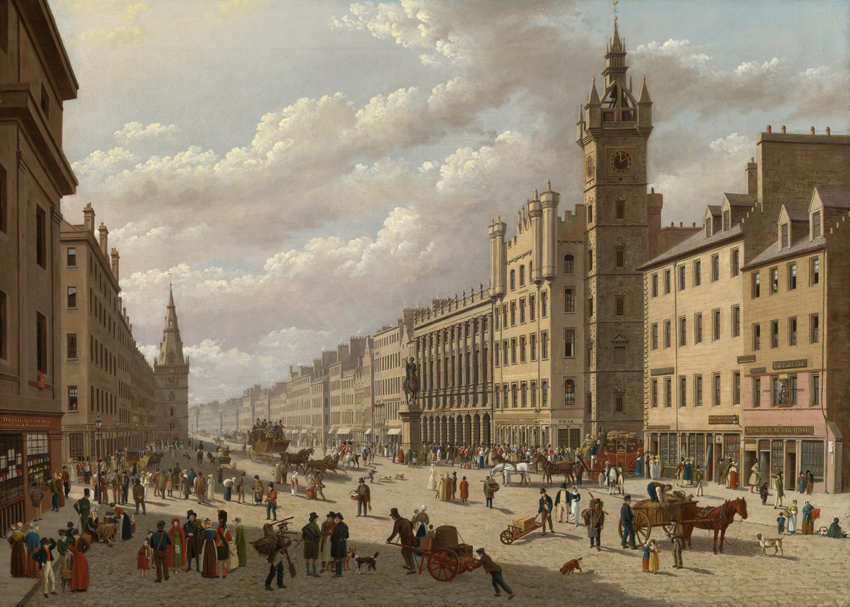
One of my favourite artworks in a museum is John Knox’s Old Glasgow Cross. It’s not only the way the painting shows a scene full of people and life, but it helps you feel like you can see 1800s Glasgow. It also connects us to the present, while the horse and carts have long gone replaced with buses, e-bikes, and cars, many of the buildings or scenery remain the same or look similar (with the clock tower) still standing tall.
Yet there is another side to it; much of the scene painted by Knox highlights some of Glasgow’s connections to British colonialism and transatlantic slavery. The painting shows a statue of King William III, depicted on horseback. William is best known for replacing James 2nd in the ‘Glorious Revolution’ and strengthening British rule in colonial Ireland, with a key part of this being the oppression of Irish Gaelic and Catholic communities. William also owned shares in the Royal African Company, a firm that trafficked enslaved Africans and profited from slavery. His statue still stands in Glasgow’s Necropolis today.
Elsewhere in the painting are the Tontine rooms, which at the time were Glasgow’s social and commercial headquarters and a key meeting place for many of Glasgow’s merchants, some of whom made fortunes through both transatlantic slavery and the wider empire. This painting is one example of many artworks and objects in museums across the UK that, once you scratch a bit below the surface, connect to histories and legacies of Empire. Acknowledging and addressing these histories and their impact today raises many questions for us. What is the role of a museum in this? How can it be addressed in a way that respects the memories of those who were colonised or enslaved? How do we connect the past to the present?
Empire at the Heart of Our Museums
Often seen as politically neutral spaces, museums are sites of education, understanding and play a key role in shaping memory and who and what gets remembered. A poll commissioned by the Repair Campaign in 2025 found that 89% of a representative sample of more than 2000 people were unaware British enslavers had enslaved people in the Caribbean for more than 300 years. As sites of education and understanding museums have a role to play in challenging that lack of knowledge.
The histories of slavery and empire are directly a part of our museum spaces. In Glasgow, Kelvingrove Art Gallery and Museum was opened with an international exhibition in 1901 built using the profits of a previous international exhibition in 1888. Both exhibitions would not have been possible without Glasgow’s empire connections. The India and Ceylon (Sri Lanka) section of the 1888 international exhibition was convened and part funded by John Muir of Deanston, at that time Muir was in sole control of the Glasgow-based James Finlay & Co., one of the world’s largest companies, which made huge profits across the British Empire through tea, textiles and cotton.
The Glasgow Life Museums collection, like many across the UK includes objects that were looted through violent colonial wars fought in the name of British imperial expansion and other objects that would not be in Glasgow today if wasn’t for Empire and the opportunities it gave people from Glasgow to move across the world, whether as sailors, missionaries, engineers or soldiers.
Similar histories, run through museums and collections across the UK. This places empire at the heart and foundation of many of our key heritage institutions and places a responsibility on them to address and acknowledge the impacts and legacies of empire and slavery today. How to address them can feel like a huge question and it is, there is no one right or wrong answer but it’s important to reflect on what can work and why it’s important for museums to try.
Glasgow City of Empire: A Lasting Legacy
In 2023, Glasgow Life Museums opened Glasgow – City of Empire, a permanent display examining the legacies of colonialism and how they have shaped the city. Co-curated with the OSCH (Our Shared Cultural Heritage) Changemakers, the display explores slavery, exploitation and oppression, as well as resilience and resistance. Drawing on the collections of Glasgow Life Museums, it combines historic and contemporary objects to explore how we can better address the histories and legacies of transatlantic slavery and British colonialism.
One way the display does this is by exploring the histories of slavery and empire through the lens of resistance. A print entitled View of the Island of Jamaica, originally produced as a piece of colonial propaganda, presents plantation life as peaceful and idyllic, omitting the racialised violence that went hand in hand with plantation slavery. In Glasgow – City of Empire, the print is presented alongside interpretation focusing on resistance to slavery, particularly Tacky’s Revolt of 1760–1761, one of the largest uprisings against enslavement in the Caribbean before the Haitian Revolution. Resistance is a critical part of the history of enslavement. By exploring these histories and presenting them to the public, museums can challenge narratives that portray enslaved people as passive and accepting of their enslavement, and present a history of slavery that better memorialises those who were enslaved.
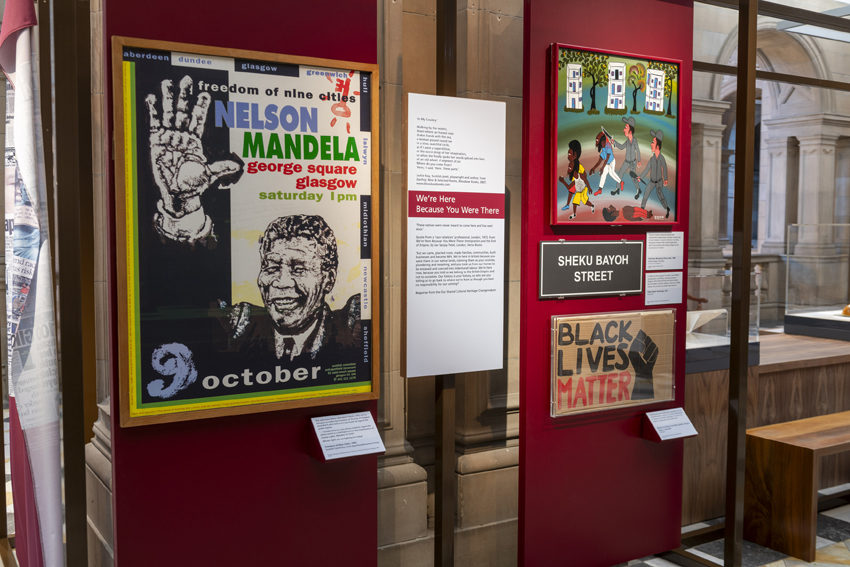
Another key theme of the display is contemporary anti-racism movements in Glasgow. These movements have often campaigned for social justice and better representations of history in museums. An integral part of engaging audiences with history is highlighting how it continues to shape society today. Much of modern-day racism has its roots in the histories of slavery and empire. Empires such as the British Empire relied on ideologies of white supremacy to justify colonial oppression and chattel slavery. The creation of racial hierarchies was central to the maintenance of empire. Many of the stereotypes and racist attitudes towards Black and minority ethnic people in the UK today have their origins in imperialist propaganda and racist ideologies used to justify colonisation and transatlantic slavery.
Many of the themes and approaches developed by the display’s co-curators have since influenced the work of Glasgow Life Museums.
Old Painting, New Narrative
In September 2025, Glasgow Life Museums redisplayed a portrait in the Glasgow Stories gallery at Kelvingrove. The portrait had long been displayed in the People’s Palace, Glasgow’s social history museum. Donated to Glasgow Museums in 1950 by John Duncan, a descendant of John Glassford, it depicts Glassford with his family and an enslaved child. Glassford was one of Glasgow’s tobacco lords: merchants in the 18th century who made their fortunes trading in tobacco, a crop dependent on the exploitation of enslaved people working on plantations in the Americas and the Caribbean.
The presence of an enslaved child in the portrait had long been the subject of rumour. Some rumours suggested that the child had been painted out to conceal the family’s connections to enslavement, given the strong support for abolition in 19th-century Glasgow. However, work by Glasgow Museums conservators in 2007, as part of a project marking the bicentenary of the abolition of the slave trade, showed that the child had not been deliberately painted over or concealed. The legend of the enslaved person painted out of the portrait behind John Glassford could therefore be dismissed: gentle cleaning revealed that the child had simply been obscured by centuries of dirt.
There is much we still do not know about the enslaved child. We do not know his name, where he was born, how he was trafficked to Scotland or what became of him. Contrast this with the other children in the painting, whose names and lives are much better documented. Christian Glassford, one of the young girls in the portrait, went on to marry James Hopkirk, whose father, Thomas, was also a tobacco lord. Their eldest son, also called Thomas, later played a key role in founding Glasgow’s Botanic Gardens.
During the era of transatlantic slavery, a small number of enslaved people were trafficked to Scotland. Alongside the millions of other Black men, women and children who were enslaved, their histories and lives are often missing from historical records and archives.
The records that do document the experiences of enslaved people trafficked to Scotland are often found in databases such as Runaway Slaves in Britain. These record acts of resistance through newspaper advertisements placed by enslavers attempting to recapture people who had escaped enslavement. The Glassford portrait is one of the few visual records of a Black person in 18th-century Scotland, highlighting its importance both as an artwork and as a historical document. This made the prospect of redisplaying and recontextualising it particularly significant, allowing us to question how we might see and interpret the portrait differently: from the perspective of the enslaved person rather than that of his enslaver.
The aim of making the enslaved child the central focus and exploring the portrait from his perspective raised a wide range of questions and challenges. Two workshops and a series of discussions with Glasgow City Council’s Anti-Racist Conversations in School group were key to developing our approach. The group comprises secondary school pupils from a range of Glasgow schools. During our discussions, we asked them for their thoughts on the painting, including what they would call it and what the enslaved child might say if he could speak. These workshops and discussions were integral to shaping the redisplay.
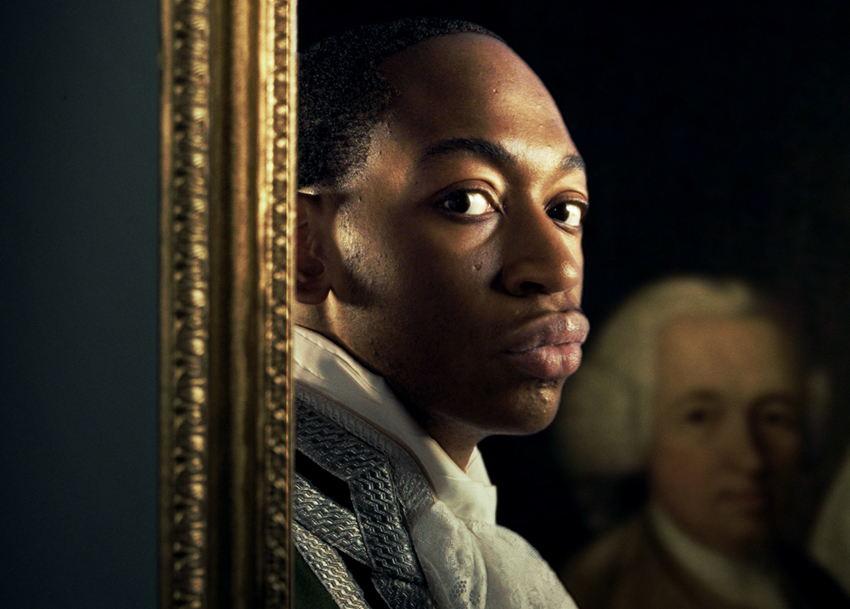
As the initial work progressed, it became clear that digital interpretation, alongside text-based approaches, would be essential. In developing the digital interpretation, we aimed to bring the discussions from the workshops to life. These included questions about why we know so little about the enslaved child, what he might say to us today if he could speak, and how we could give a voice to someone about whom so little is known. We decided to produce a short in-gallery film featuring a young actor playing the enslaved child. The film reflects on some of the questions raised by his presence and explores how histories of enslavement, memorialisation and power intersect.
The Glassford Family Portrait now hangs in Kelvingrove’s Glasgow Stories gallery. The approach taken to its redisplay builds on other work undertaken by Glasgow Life Museums in recent years to reframe narratives around slavery and empire. This work seeks to broaden those narratives to encompass Glasgow’s connections to the British Empire and transatlantic slavery, as well as the histories of the people who were enslaved and colonised. It continues to raise questions about how power shapes our understanding of history and how this, in turn, affects Glasgow today.
What museums can be
Having been involved in a range of anti-racist, anti-oppression and decolonial projects in museums over the past two or three years, one of the key reflections that comes to mind is that these projects speak to what museums can be. By better addressing and acknowledging the histories and legacies of slavery and empire in museum spaces, we can begin to challenge our own institutions’ histories and recognise the ways in which many museums have benefited from colonialism. We can also help ensure greater acknowledgement, reflection and remembrance of the lives of those who were enslaved. Finally, we can work with community groups, activists and others to make the world a better place.
Nelson Cummins
Curator of Legacies of Slavery and Empire, Glasgow Museums
Published 22 October 2026