
Manchester Museum reopened in 2023 following a £15m transformation. The hello future project was driven by the belief that museums have an extraordinary power to build understanding and empathy between cultures, across generations and time.
Following an ambitious £15m transformation, Manchester Museum reopened to the public in 2023 with the aim to build greater understanding between cultures, a more sustainable world and to bring to life the lived experience of diverse communities through the Museum’s collections and new displays.
On the redevelopment, Esme Ward, Director of Manchester Museum, comments: “The reopening marks a huge moment in Manchester Museum’s rich history. We have extended the building, making room for more joy and learning and evolving into the Museum Manchester needs. Beautiful new galleries and exhibitions showcase the best of the Museum’s historic collections, as well as addressing the urgencies of the present day and highlighting the complexities of our world. We have also listened to advocates with lived experience and inclusive new spaces and features are incorporated throughout.”
Manchester Museum, part of the University of Manchester, first opened in 1890 and is recognised as one of the largest university museums in the UK. The original neo-Gothic building, designed by Alfred Waterhouse (1830–1905), is home to around 4.5 million objects from natural sciences and human cultures. Proud to be the world’s first Carbon Literate Museum, the team has recycled and reused as much material as possible from within the museum during renovation works.
Designed by Purcell, the modern two-storey extension houses a major new Exhibition Hall and South Asia Gallery, alongside a new accessible entrance from Oxford Road and a new cafe and shop. The extension is clad in green-glazed terracotta tiles and pays homage to craftsmanship as well as Victorian and Edwardian period buildings in Manchester. Other new features include a Changing Places toilet, prayer room, quiet room, picnic area and therapy room.
Exhibition Hall
The Exhibition Hall is home to ambitious shows that explore past, present and future and engage with global and local narratives. The opening exhibition, Golden Mummies of Egypt, offers visitors access to the Museum’s world-class Egypt and Sudan collection and challenges Victorian narratives of ‘ancient Egypt’ through research from the University of Manchester.

South Asia Gallery
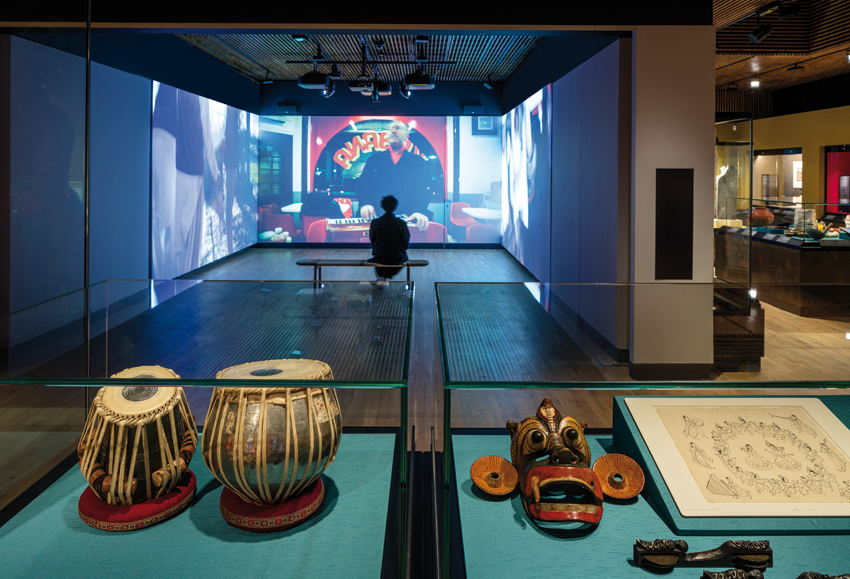
The South Asia Gallery, a British Museum partnership, is the first permanent gallery in the UK to celebrate the lived experiences and contributions of the South Asian diaspora. Co-curated with the South Asia Gallery Collective, a group of 30 individuals including community leaders, educators and artists, the gallery explores the connection between South Asia and Britain and the legacy of Empire alongside contemporary South Asian culture and creativity, perspectives that have not been presented before. Divided into 6 anthologies, the Collective has grappled with a range of subjects through 140 artefacts, including one of the collective’s great-grandfather’s World War I uniform, a rickshaw imported from Bangladesh and decorated by communities in Manchester, a new commissioned mural from British artists, The Singh Twins – an emotional map of South Asian diaspora experience – and a Cartier brooch containing a repurposed carved emerald from the Mughal Empire. At the heart of the gallery is also a dedicated space for performance, film and participatory activities.

Lee Kai Hung Chinese Culture Gallery
The Lee Kai Hung Chinese Culture Gallery highlights personal stories of migration, friendships and collaboration to inspire empathy and build understanding. Developed in partnership with the University’s Manchester China Institute, it draws on historical and contemporary links between Manchester and China. Showcasing rarely and never-displayed collections from cultural partners across the city, personal stories and objects include a late Qing dynasty (1636–1912) ‘Manchu’ headdress decorated with blue kingfisher feathers, a 20-metre scroll showing Emperor Kangxi’s birthday procession through the streets of Beijing in the 18th century and a taxidermy milu deer, once on the brink of extinction but now thriving in China after decades of transnational conservation efforts. A night sky constellation – our shared sky – also encourages people to gather and connect through cultural exchange and performances.
Dinosaur Display
One of the Museum’s most visited exhibits, the prehistoric giant Stan the Tyrannosaurus rex, returns alongside a new addition, April the Tenontosaurus. The Museum worked with a team of Earth Science students from the University of Manchester, whose new research and several years of cataloguing have allowed April’s skeleton, dating back to the Cretaceous period and found in Montana, USA, to stand on all fours again. Positioned next to the historic Fossils Gallery, the brand-new Dinosaur display also teaches visitors Palaeontology enthusiasts will learn what it means to think like a palaeontologist at the brand-new Dinosaur display next to the historic Fossils Gallery. Our changing world is a focal point throughout, with featured objects such as fragmented rock showing the moment the asteroid hit Earth, relating to our understanding of evolution, climate change and outer space.

Belonging Gallery
The Belonging Gallery captures the welcoming spirit of the Museum, drawing upon the Museum’s collections and diverse cultural perspectives to reflect on what it means to belong. Following an open call, the exhibition presents the work of multiple visual storytellers, who bring their own life experience to comic art. Aiming to rewrite the past and inspire new futures, works include Indigenous and African Futurism explored alongside artefacts and natural history specimens from the collections. Stories include the climate migration of the first people to Britain during the last Ice Age and the story of a Syrian refugee’s life jacket, collected in 2017 by Bryan Sitch, Deputy Head of Collections.
The Belonging Gallery has been curated by Alexandra P. Alberda, the first-ever Curator of Indigenous Perspectives at Manchester Museum. She was appointed to take forward the innovative ‘Indigenising Manchester Museum’ programme, funded by the John Ellerman Foundation, which sets Indigenous perspectives at the heart of the Museum. She is also undertaking provenance research with source and diaspora communities as part of the Museum’s proactive approach to repatriation.
To find out more about the project visit: manchester.ac.uk/museum
First published in the 2023 print edition of Museum-ID magazine (12 October 2023)