

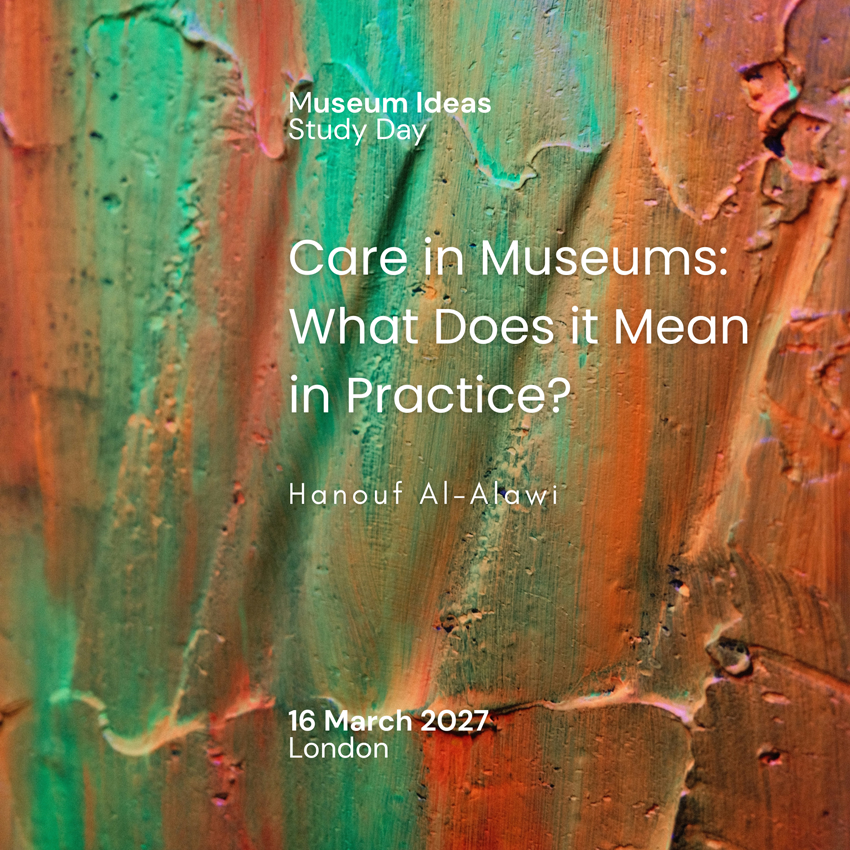
Care is a word increasingly present in conversations about museums. But what does it actually mean in practice?
Is care something we offer through individual relationships, or should it be embedded in the structures, decisions and spaces of our institutions? How does it shape the language we use, the stories we tell, the programmes we design and the ways people experience our museums?
This study day offers an opportunity to explore these questions collaboratively, reflecting on what it means to work with care across museum practice, from learning and community engagement to interpretation and exhibition spaces.
Rather than presenting care as a fixed methodology or a set of techniques, we will consider how it emerges through relationships, facilitation, language, space and institutional culture. We will consider how museum encounters are shaped not only by collections and content, but by the social, cultural and emotional conditions through which people encounter them: that meaning is relational, shaped through context, memory and lived experience.
We will explore questions of attention, trust, belonging, emotional safety and shared meaning-making; how care shapes the experiences we create through interpretation, learning, participation and exhibition design; how care can become compromised, and the tensions between our aspirations and the practical realities of museum work; how we facilitate encounters with objects and histories that may evoke recognition and curiosity, but also discomfort, memory or difficult conversations; and what it means for care to move beyond the intentions of individual practitioners and become embedded within institutional practice.
Drawing on case studies, provocations and the collective experience of participants, the day will create space for reflection, dialogue and shared learning. We will consider where care is already present in our work, where there is room for change, and how we might develop a shared understanding of what a caring museum could look like in action.
Join us in Central London on 16 March to explore what care means for museum practice, and consider how it can shape more thoughtful, inclusive and meaningful museum experiences.
Care in Museums: What Does it Mean in Practice?
Study Day, 16 March, Central London
Led by Hanouf Al-Alawi
About the Workshop Leader
Hanouf Al-Alawi is an international museum consultant specialising in interpretation, learning and audience engagement, with more than 20 years’ experience across the UK and Middle East. She has worked with organisations including the British Museum, Natural History Museum, Royal Botanic Gardens, Kew, UNESCO and Barker Langham.
Her practice spans learning and participation, interpretation, co-creation, programme development and culturally responsive audience engagement. She is particularly interested in how museums can create spaces for connection, participation, belonging and dialogue, and how collections and interpretation can support shared meaning-making while holding emotionally and culturally complex histories. Her approach brings together audience-centred and participatory practice, inclusive interpretation and trauma-informed approaches.
Book Tickets
Click ‘Select options’ below to book your place on the study day. Tickets are available on a sliding scale from £137 – £177. Book with colleagues for multiple delegate discounts. Book your ticket online below or email info@museum-id.com if you prefer to be invoiced.
Want to join us for several study days? You can save with our 2027 Study Day Ticket Bundle.
-

Study Days
Select options This product has multiple variants. The options may be chosen on the product page
20% of tickets are available at a reduced rate for museum workers who may often be excluded from training and professional development opportunities, including people of colour, LGBTQ+ members of staff, students, freelancers, and those working at small independent museums. Reduced rate tickets are £97 – email info@museum-id.com to check availability and to book a ticket at the reduced rate.
Tickets are non-refundable but may be swapped between colleagues at the same organisation and between different study days (if places are available). If the workshop is postponed, your ticket remains valid for the rescheduled date.