
Caroline Smith, Children and Young People’s Leadership Manager at The National Gallery, and Dr James Mannion, Associate, Oracy Cambridge and Director, Rethinking Education, on how the Visions and Voices project represents a shift from seeing gallery visits as one-off enrichment opportunities to something more ambitious: a space where young people’s voices are developed, valued, and heard.
The Challenge of One-off Visits
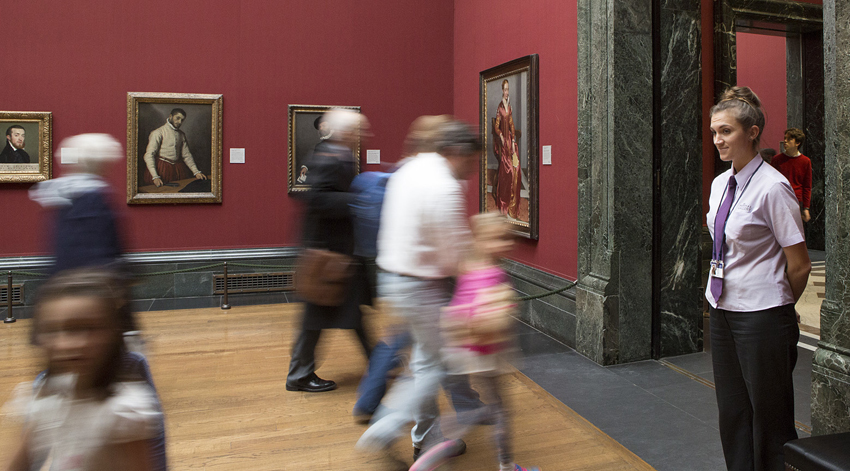
The learning team at the National Gallery has the great privilege of exploring the collection alongside a high volume of students each year. Unfortunately, we generally only get to see them once. The challenge is to make that single visit meaningful, and to sow seeds for future learning. The stakes are high: it is increasingly challenging for teachers to take students out of school, there are many competing priorities, and for many students, it may be their first time in a gallery or museum.
Talking Paintings: A Dialogic Approach
One of the most popular sessions for schools at the National Gallery is Talking Paintings, a themed exploration of a small number of artworks from the collection. Students learn about art but they also learn through art. Paintings offer a valuable lens through which to view and explore the world. They can facilitate discussion of the wider questions that matter to young people – especially those best approached indirectly, such as around identity, inequality or climate.
Talking Paintings sessions are conversational and investigatory rather than didactic. Teaching is dialogic. The sessions create space for shared learning through talk, allowing participants the opportunity to practise articulating their thinking, and to respond to – or build on – the ideas of others. Even within a short visit, students can benefit from a nurturing climate where they hear others modelling language use, and are encouraged and prompted to develop their own thoughts.
These sessions continue to be popular, and we have gathered extensive anecdotal evidence that they both support learning and facilitate wider, thoughtful conversations. But how could we test this more robustly? And how might we make them even more effective, by improving the quality of the conversations between gallery educators and visitors?
From spark to strategy: Designing Visions and Voices
Initial workshops with Oracy Cambridge during the 2021 lockdown helped us identify opportunities for developing oracy skills through these sessions, and to explore the changes we wanted to make. From this emerged Visions and Voices, a five-year project focused on using the collection as a stimulus for oracy education – learning to talk, learning through talk and learning about talk.
The project aims to explore the conditions that support effective learning through talk, from the perspective of both participants and facilitators, and to examine what this means in practice for the delivery of Talking Paintings sessions. What should facilitators do differently? What should they encourage participants to do? What strategies and tools can help?
What the project involves
Three schools in and around London were recruited to take part, each paired with two gallery educators. While each school had already identified oracy as a priority, they were at different stages of implementation. The project began with a year of planning and training, and in September 2023 we started working directly with a cohort of around 80 Year 7 students. We will follow this group through Years 8 and 9; at the time of writing, we are about to enter the fourth year of the five-year programme – the third year working directly with students.
Each year, students take part in six sessions: three at the Gallery, and three in their schools, facilitated by gallery educators. These are supported by termly training sessions led by Oracy Cambridge, bringing together staff from both the schools and the Gallery. Together, they co-plan the sessions and organise the groupings – a particular challenge in the first term of Year 7, when students and teachers were just getting to know one another.
Each year, we cover three key aspects of oracy education: group discussion, philosophical inquiry, and presentational talk – building on their experiences year by year. Every session is rooted in the National Gallery’s collection. Paintings serve as the starting point for activities designed to promote high-quality exploratory talk, helping students grow in confidence and develop their ability to express and refine their views. Between sessions, the gallery educators meet to reflect on what worked well, what didn’t, and how to adapt for the next phase of the project.
Building capacity: Training gallery educators
One of the most distinctive features of the programme is the sustained professional development for gallery educators, facilitated by Oracy Cambridge. Across the first three years, we have explored:
● Group talk: Based on the Oracy Skills Framework, we focus on developing exploratory talk – where students reason together, listen actively, give reasons for their views, and build or challenge each other’s ideas respectfully. We created classroom ground rules and talk goals, using activities such as ‘talking points’ and a range of collaborative groupwork strategies, including envoys, jigsaws, fishbowls, traverses, and ‘save the last word’.
● Philosophical inquiry: We’ve used the P4C (Philosophy for Children) model, including stimulus-based questioning, student-led inquiry circles, and reflective closing rounds. Facilitators practised designing open-ended questions and scaffolding deeper dialogue using a toolkit of prompts – from ‘What do you mean by that?’ to ‘How might someone else see this differently?’
● Presentational talk: This strand focuses on speaking with clarity, confidence and intention. Students explored voice, posture and gesture, and practised short speeches. Sessions sometimes incorporate performance elements, such as storytelling or using TikTok-style video clips to boost engagement.
● Creative pedagogy: We also welcomed guest educator Hywel Roberts, whose work on Botheredness brought a powerful energy to training. He demonstrated how dramatic techniques and imaginative framing can help ‘hook’ students into a painting and encourage them to express their thoughts and ideas in a safe way.
The gallery educators – already a highly experienced group – have taken these ideas and made them their own. Over time, the team has grown in confidence not just in using oracy strategies, but in seeing themselves as oracy educators. Their skill in prompting, questioning, and creating space for student voice has deepened noticeably across the programme.
What We’re Learning
Visions and Voices is an iterative, research-informed programme, with ongoing evaluation built in. The first-year evaluation report, conducted externally, drew on surveys, interviews, observations, and student feedback.
Key findings include:
● Engagement: 88% of students enjoyed the sessions; 81% enjoyed talking about the paintings; 69% said they were curious to learn more about the collection.
● Confidence: 76% said the programme made them more confident talking about paintings, and 69% felt more confident speaking in front of others.
● Learning: Students showed increased ability to share ideas, build on each other’s thinking, and engage in respectful disagreement – especially when sessions were well-scaffolded and delivered in small, inclusive groups.
● Challenges: Some students and facilitators found philosophical inquiry more difficult to grasp. There were also logistical challenges around school coordination and creating the right environment for talk.
The evaluation also found that students were more likely to engage deeply when they chose the painting or took the lead in the discussion – a reminder that agency matters.
Here are some direct quotes that capture what participants have taken away from the project so far:
I learnt art is fun. (Student)
I thought art galleries were just places for paintings… but I’ve realised they are places where they want you to see what art actually is. (Student)
I got more confident because they encourage you. (Student)
The painting opened up my heart a bit. (Student)
Now I feel more confident in speaking in front of people I didn’t really know. (Student)
It really helped me to give my opinions. (Student)
I wasn’t very confident at speaking out loud but now I’m more confident. (Student)
I have seen a huge change from the first session to the last session in students talking. (Teacher)
I think they have better discussions in the gallery, like I feel like they communicate in a deeper, conceptual, meaningful, expressive way. (Teacher)
It built up my knowledge and confidence on what actually is oracy and how to visualise it within a classroom. (Teacher)
It’s been really exciting, I mean for me personally, as someone who was a classroom teacher. This has been the closest I’ve felt to being back in the classroom, both in being sort of physically there, but also the fact that I get to know the kids better. (Facilitator)
The Road Ahead
We’re now entering the final year of working directly with students, as they begin Year 9. This phase will focus more on presentational talk. In the fifth and final year of the programme, we’ll pause to reflect on what we’ve learned and explore how best to share it. The project team will consider how best to capture and share the insights, resources, and strategies developed – with a view to supporting other museum and gallery educators to embed oracy into their practice.
This may include:
● Creating resources and a toolkit for wider use
● Developing new training offers for cultural educators and teachers
● Sharing case studies and student outcomes more widely
Ultimately, Visions and Voices represents a shift from seeing gallery visits as one-off enrichment opportunities to something more ambitious: a space where young people’s voices are developed, valued, and heard.
Caroline Smith, Children and Young People’s Leadership Manager, The National Gallery
Dr James Mannion, Associate, Oracy Cambridge and Director, Rethinking Education
Published 8 December 2025