
Iheanyichukwu Onwuegbucha and Will Rea on curating the museum at the John Randle Centre for Yoruba Culture and History in Lagos, Nigeria
The development of the John Randle Centre for Yoruba Culture and History is a striking addition to Africa’s commitment to conserving its cultural heritage. The centre marks a definite shift in thinking through the appropriate forms of museology for a continent that has long been hidebound by national museums developed during the peak of colonial impact. Developed to replace the John Randle pool and meeting hall, which had become decrepit and unusable during the years of military dictatorship, the centre is a reimagining that pays homage and credence to John Randle’s legacy.
Randle, a Yoruba man, was a doctor and an enthusiastic sportsman who experienced discrimination at the British clubs in Lagos. Motivated by the numerous drownings he witnessed in Lagos harbor, he built a swimming pool, which was later complemented by a large meeting hall. In 2017, the old site was removed, and SI.SA architects, led by Seun Oduwole, were commissioned to reimagine the site. They determined that the Randle should be reimagined as a destination point for celebrating Yoruba culture. The new site incorporates a swimming pool and meeting venues, but the standout innovation is the cultural centre which includes a museum.
Before the Randle museum project, there were several calls for African museums to break free from colonial modes of exhibiting. By embracing a postcolonial model, the curatorial and design strategy positioned the museum as an active community space rather than a passive repository of artifacts. For the curators led by Dr Will Rea, together with Iheanyi Onwuegbucha, Sir Martins Akinabimu, Mayo Ogundiran, and Aderemi Adegbite, the central question was: What should a Yoruba museum look like in the 21st century and how would such a museum be made relevant to both the Yoruba people and a broader, global audience? The task was to build an exhibition that would capture the rich and complex history of the Yoruba, who are not only rooted in western Nigeria but whose presence stretches across West Africa and into the African diaspora.
One of our greatest initial challenges was the lack of a pre-existing collection. In Nigeria, public institutions often struggle to gain access to privately held art collections, while state-owned collections are frequently difficult to access. However, what seemed like a daunting obstacle became a rare opportunity to build something entirely new, free from the constraints of an inherited collection.
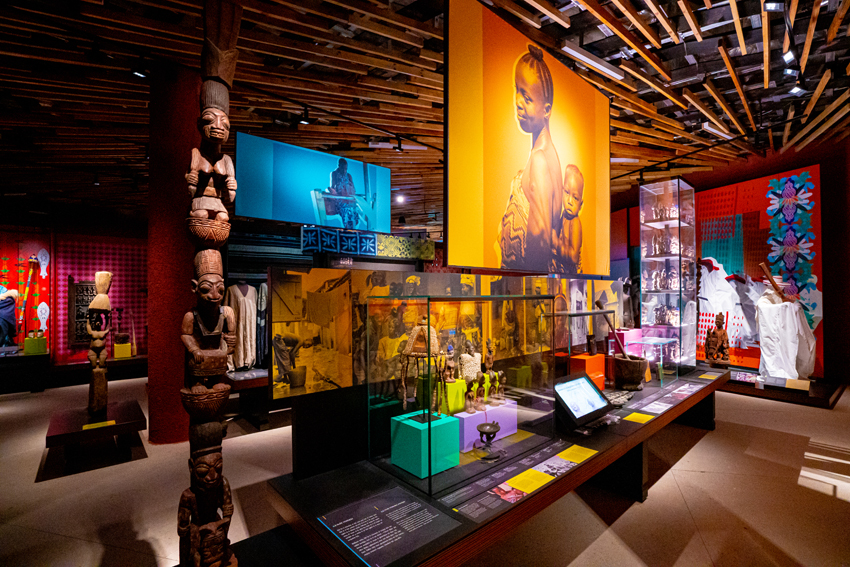
The openness of the design, the use of sound and the development of particular design elements – not least the use of colour – are all very deliberate attempts to rethink the idea of the museum in Africa
Sound plays a central role in the curatorial scheme. In many ways, the museum is based on Rowland Abiodun’s work, which seeks to integrate the visual and verbal arts of the Yoruba people. Taking their cues from initial early meetings between Abiodun, Henry Drewal, Jacob Oluponna, and Will Rea, the curatorial and design teams, led by Phil Hughes at Ralph Appelbaum Associates, sought to bring a rich oral tradition into the museum’s landscape. The openness of the design, the use of sound and the development of particular design elements – not least the use of colour – are all very deliberate attempts to rethink the idea of the museum in Africa. Based on the representation of a particular culture, the most apparent issue is that the work falls into a form of ethnographic representation and the museum becomes more closely allied to museums of ethnography. This is the colonial precedent – particularly under British colonial rule, national museums represented African culture as static and often divided into ‘tribal styles’ – corresponding to the political divisions of British indirect rule. Art was also regarded as traditional, unchanging and only developing under the guidance of European input. Clearly this is a model that is unsustainable for a nation and a people that are, in many ways, at the forefront of innovation, and which, despite the colonial model, always have been.

The museum’s opening section presents a series of mythical representations, the founding structure of Yoruba beliefs – from the creation of the world at Ile Ife to the generative figures of the Oriṣa – the pantheon of deities that have sustained Yoruba life and culture. Opening from these first rooms, the audience is presented with a panorama that celebrates Yoruba life and culture – from the skilled work of woodcarving and weaving to the centrality of the market place. It is an attempt to represent a Yoruba logic of thought, based on the urbanism of social life and the centrality of kingly authority. In part the section on Culture and Practice is an imagining, albeit on that is based on long term and in depth relations with Yoruba culture in villages and towns across Nigeria. Yet ‘Yoruba’ is itself partially an imagined construct of the 19th century – of civil wars and slavery, the translation of the bible by Samuel Crowther (the first African Bishop) and colonial rule as well as an attention to the way in which the Yoruba gods have crossed the Atlantic – a wider Yoruba culture that contributes to the Atlantic World. Movement into the modern Yoruba occurs through this history, but centrally it is in the handing over of tradition that makes this modern world sing – whether literally in the use of Oriki praise poetry by Fela Kuti or the adaptations of Aṣo Oke cloth by modern designers. A final section allows for the imagining of artists and makers, thinking the traditions into the future and what that might mean for Lagos, for Nigeria and for the world.
The museum represents a bold step forward in postcolonial African museology. The building’s innovative design and the extensive scope of its displays signal a promising future
In many ways, the museum’s design reflects the dynamism of contemporary Yoruba society. In our effort to create a museum that is neither ethnographic nor a modern art gallery, the Randle Centre breaks new ground in museum design and curation. It demonstrates that it is possible to honor culture while simultaneously embracing innovation and modernity. The museum exemplifies a strong commitment to ensuring that African museums offer quality and experiences on par with any European museum and represents a bold step forward in postcolonial African museology. The building’s innovative design and the extensive scope of its displays signal a promising future. It has already inspired the “Museum in Africa” workshops, scheduled for October 29 to November 2, 2024. Organized by the Living Object Foundation and coordinated by Iheanyi Onwuegbucha, these workshops will bring the Randle design and curatorial team together with leading curators from across Africa, fostering a determination to share knowledge throughout the continent.
Dr Iheanyi Onwuegbucha
Assistant Professor of Modern and Contemporary African and Caribbean Art, University of Cambridge
Dr Will Rea
Senior Lecturer in African Art History, University of Leeds
Interpretation and Exhibition Design: John Randle Centre for Yoruba Culture and History
The John Randle Centre comprises a permanent exhibition, library, flexible multipurpose rooms, seminar and performance spaces, two restaurants, a public pool and landscaped area with a market square. It forms an important destination as part of plans to transform the Marina and Onikan region into a hub for tourism and recreational activity. Located on the former site of the first public swimming pool in Lagos, the erection of a new Centre has returned a much loved and missed recreational resource to the heart of Lagos Island.
Although the John Randle Centre is funded by the state of Lagos, it was SI.SA, a local architectural firm led by Seun Oduwole, who first envisioned the regeneration of the site. Along with SI.SA, RAA were involved from the earliest stages of the project, hosting meetings of the academic panel and coordinating collections development. Over seven years, the firm provided an interpretation plan, exhibition design and monitoring, website design, artworking and media design.

The architecture of the Centre takes its cue from traditional Yoruba architecture and craftsmanship, using visual metaphors to reflect the strong art and philosophical origins of the language and culture. The building form responds to its context in the shape of a fractal, which rises from the earth and leans forward as a nod to Itesiwaju, reflecting the progressive nature of the Yorubas. Finished in a dyed Tyrolean, the building evokes the mud aesthetic of old Yoruba architecture. A green roof ties the building to the landscape and helps to reduce the building’s thermal load.
RAA worked closely with SI.SA to ensure the building and exhibition design evolved in tandem, crafting a journey through the new building that would best support the exhibition narrative. The result of this close collaboration is an exhibition that embodies the best of Yoruba culture: from wood carving to fashion, from literature and theatre to weaving and fine arts. Celebrating the many, ever-changing aspects of Yoruba culture, the narrative guides visitors on a path from a time of myth and legend into the modern world and on to the future.
The exhibition is divided into four main areas: ‘Beginnings’ looking at Yoruba myths and legends, ‘Custom and Practice’ exploring Yoruba practices that originate from before the time of colonisation, ‘Modern Yoruba’ – the flowering of Yoruba culture since Nigeria’s independence, and ‘Future Yoruba’ with artist visions of possible Yoruba futures. The look and feel of each area is inspired by elements of Yoruba culture, with a bright, vibrant colour palette and artistic, physical and performance features. Playful and multisensory elements add a sense of fun and promote the Centre’s mission of celebration.
Ralph Appelbaum Associates

The Architect’s View: John Randle Centre for Yoruba Culture and History
Onikan, the cultural heart of Lagos Island, is layered with history, culture and heritage. The intersection of indigenous and colonial histories shaped the social and urban fabric of this part of the city, lost to years of development and neglect. Dr John Randle, a prominent Lagosian, built a public swimming pool in 1928 in King George V Park, later to become the Love Garden – a popular recreational area. This gesture was inspired by the refusal of the British Colonial Office to build a swimming pool for Lagosians to learn how to swim. A memorial hall, also built within the park, became an important creative hub in 1960’s Lagos. In 2016, the Lagos state government decided to regenerate the Onikan area.
The John Randle centre is a series of reimaginations, and should be understood within the framework of what it seeks to replace and represent. It is a new way of storytelling, an immersion into the philosophical thought system of the Yoruba, the engagement of the spiritual, mythological and cosmological root of the culture. It is a journey into interrogating the complex layers of our distorted history and dignifying untold narratives about Yoruba heritage and civilisation. Most importantly, it is a celebration of dynamism, vibrancy, resilience and excellence. This expression was key to our vision for an African museum that reconnects with it’s past, reimagines it’s future and connects with it’s communities.
The architecture, urbanism, exhibition design and content selection intersect to provide context, depth and layering to understand the Yoruba cultural experience in its purest expression. The buildings are arranged around the periphery enclosing a landscaped area and a public square, in a nod to Yoruba urbanism. The restored pool sits adjacent to the remodelled landscape, from which the building rises towards to sky in a nod to a Yoruba proverb about circularity.
The absence of a collection at inception provided an opportunity for the academic and curatorial team to craft a research driven narrative which guided the content sourcing, collection and creation strategy: interpretative storytelling through the concept of visual and verbal oriki as guiding principles of Yoruba artistic production. Oriki are Yoruba praise poetry verbally expressed in chant, song and drumming; visually through, ritual, dance, clothing and sculpture. The essence of the Yoruba is experienced through the intersection of these oriki, layering of artefacts, old and new media, objects of recent past and digital narratives overlayed with an immersive sound environment, transporting the visitor into a Yoruba spiritual and metaphysical realm strongly rooted in context. The exhibition was designed by RAA, fabricated and installed by the Hub UK and managed by Fraser Randall.
Hopefully the centre will act as a catalyst for the emergence of more museums celebrating compelling narratives from other cultures, spark dialogue about contextual storytelling in western museums and the contribution of African knowledge systems to museological practice.
Since completing the project, we have formed a new experiential design company, Living Object Limited to take the lessons learned into new areas. Living Object is currently working on a new exhibition for the Fitzwilliam Museum and Cambridge University about resistance to the slave trade called Rise Up: Resistance, Revolution, Abolition opening in February 2025. Living Object has also established a non-profit organisation called Living Object Foundation, a vehicle which aim to rethink the role and function of museums in Africa and the global South in the 21st century, and to explore new ways of presenting, interpreting objects and stories.
Seun Oduwole, Principal Architect
First published in the 2024 print edition of Museum-ID magazine (10 October 2024)